Environmental management

Basic Philosophy (Guiding Principle)
T.RAD Co., Ltd. and the T.RAD Group aim to become the world’s No.1 heat exchanger manufacturer contributing to the realization of a carbon-neutral society. Each employee prioritizes environmental friendliness, engaging in the conservation of the environment, biodiversity and mitigate water risk, and protect natural resources contributing to the progress of a rich and bright society.
Basic Policy (Code of Conduct)
T.RAD Co., Ltd. and the T.RAD Group, in order to realize the basic philosophy, are conscious of the circular economy and nature-positive approaches. They predict and evaluate environmental impacts at all stages of the product lifecycle, set objectives and goals for environmental, biodiversity conservation and water risk mitigation utilize and continuously improve a company-wide environmental management system, and pursue the sustainable development of the company and the happiness of customers, shareholders, employees, business partners, and the local community.
- We will collaborate and cooperate with customers and business partners to prevent global warming through the reduction of greenhouse gas emissions and achieve carbon neutrality.
- We will promote the development and sales of heat exchanger products compatible with the diverse power plants of the electrification era.
- We will restrict emissions of environmental pollutants and strive to prevent environmental pollution.
- We will promote the effective use of resources and reduction of waste, striving for recycling and resource conservation.
- We will actively engage with local communities and strive to contribute to environmental and biodiversity conservation, water risk mitigation and the protection of natural resources.
- We will comply with environmental laws and other requirements, establish voluntary management standards, and strive to improve the level of environmental conservation.
- We will build and enhance environmental management and strive to enrich environmental education and awareness for all members.
- We will actively disclose environmental information and strive for mutual understanding with stakeholders.
Information Disclosure Based on the TCFD Framework
For us, climate change is one of the most important issues affecting business continuity. In April 2022, we endorsed the recommendations of the Climate-Related Financial Disclosure Task Force (TCFD)* aimed at reducing the risk of volatility in financial markets caused by climate change. We will analyze the risks and opportunities that climate change poses to our business and reflect them in our management strategies and risk management. We will also appropriately disclose the progress of these efforts and aim for further growth while contributing to the decarbonization of society as a whole.
※Established in 2015 by the Financial Stability Board, an international organization. It recommends that a company assess its business risks and business opportunities arising from climate change, identify financial impacts, and disclose information.
Governance
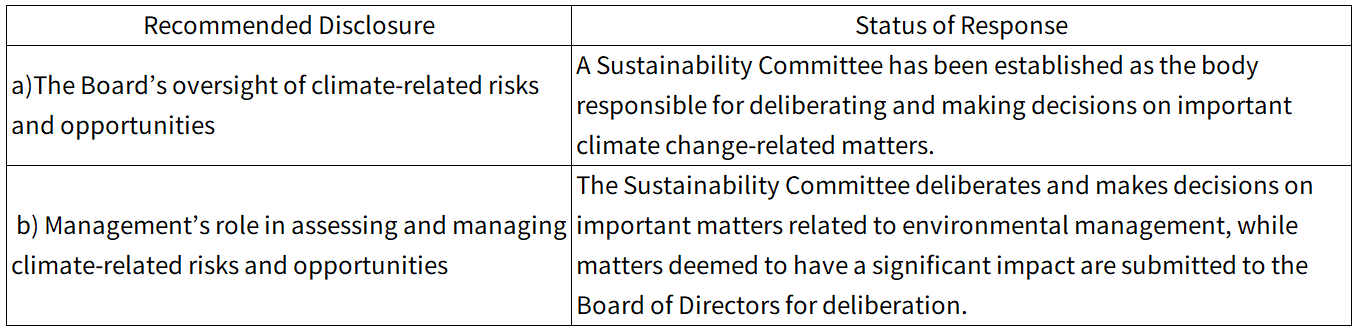
We view climate change issues as one of the most important issues for us to fulfill our social responsibilities and achieve sustainable development, and we manage them at the Sustainability Meeting. The Sustainability Committee has been established as a committee that is responsible for unifying the corporate governance system. Chaired by the President and Representative Director, the Company’s representative directors are also members, who discuss risks and opportunities, policy for initiatives, and targets related to climate change, and manage the progress of initiatives.
Positioning of the Sustainability Committee within Our Company

Strategy

We analyze climate-related scenarios based on IEA (International Energy Agency) and IPCC (Intergovernmental Panel on Climate Change) and formulate strategic plans. Demand for xEV vehicles* is expected to grow more than several times in 2050. With increased demand, governments may strengthen energy regulations associated with fossil fuels. Excessive regulation can be a risk for us. On the other hand, appropriate regulations can serve as an opportunity for business expansion by encouraging the spread and expansion of products with superior environmental performance, which are our strengths.
*xEV vehicles: HEV, PHEV, BEV, FCEV
Risk Management
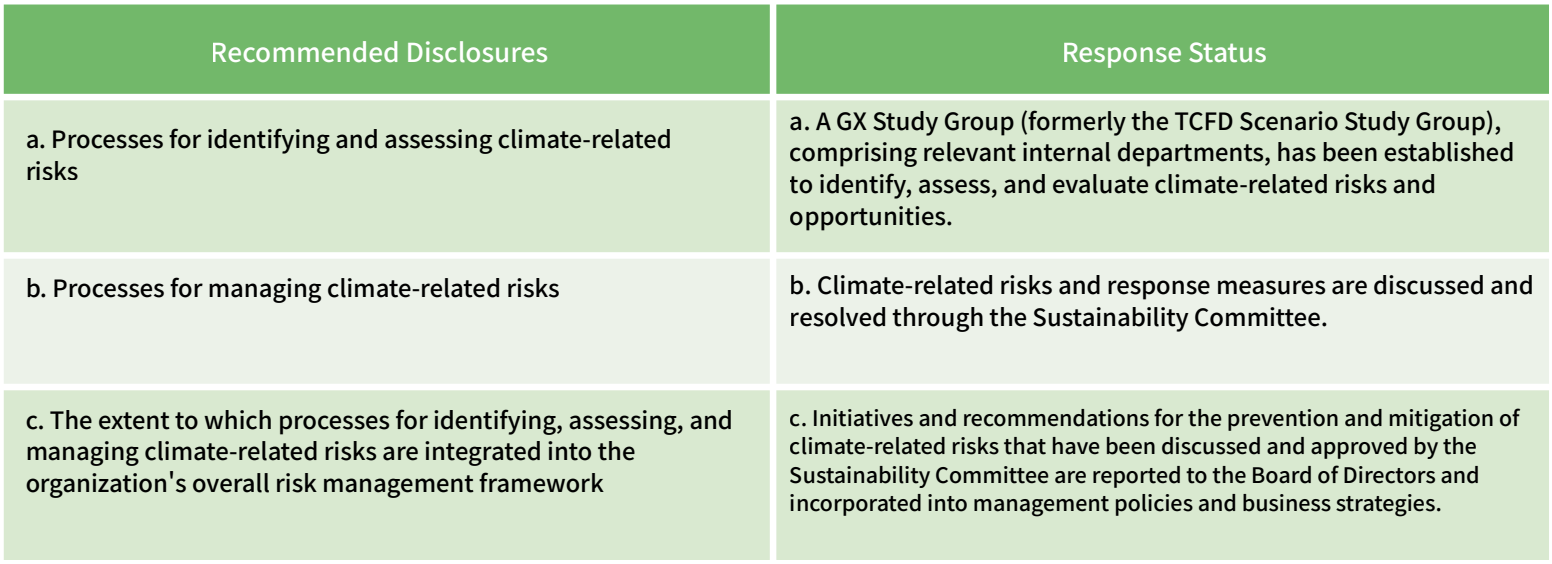
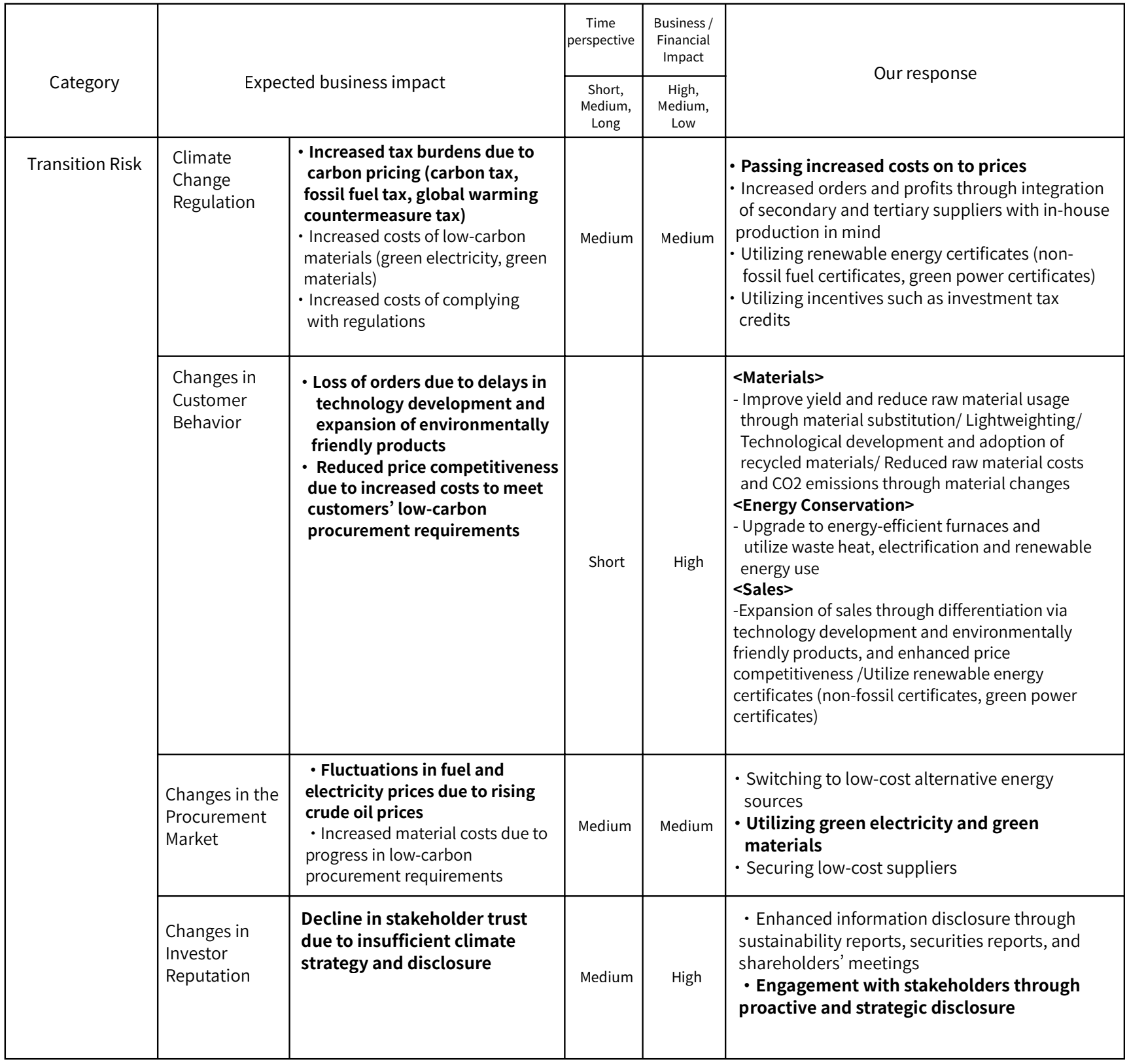
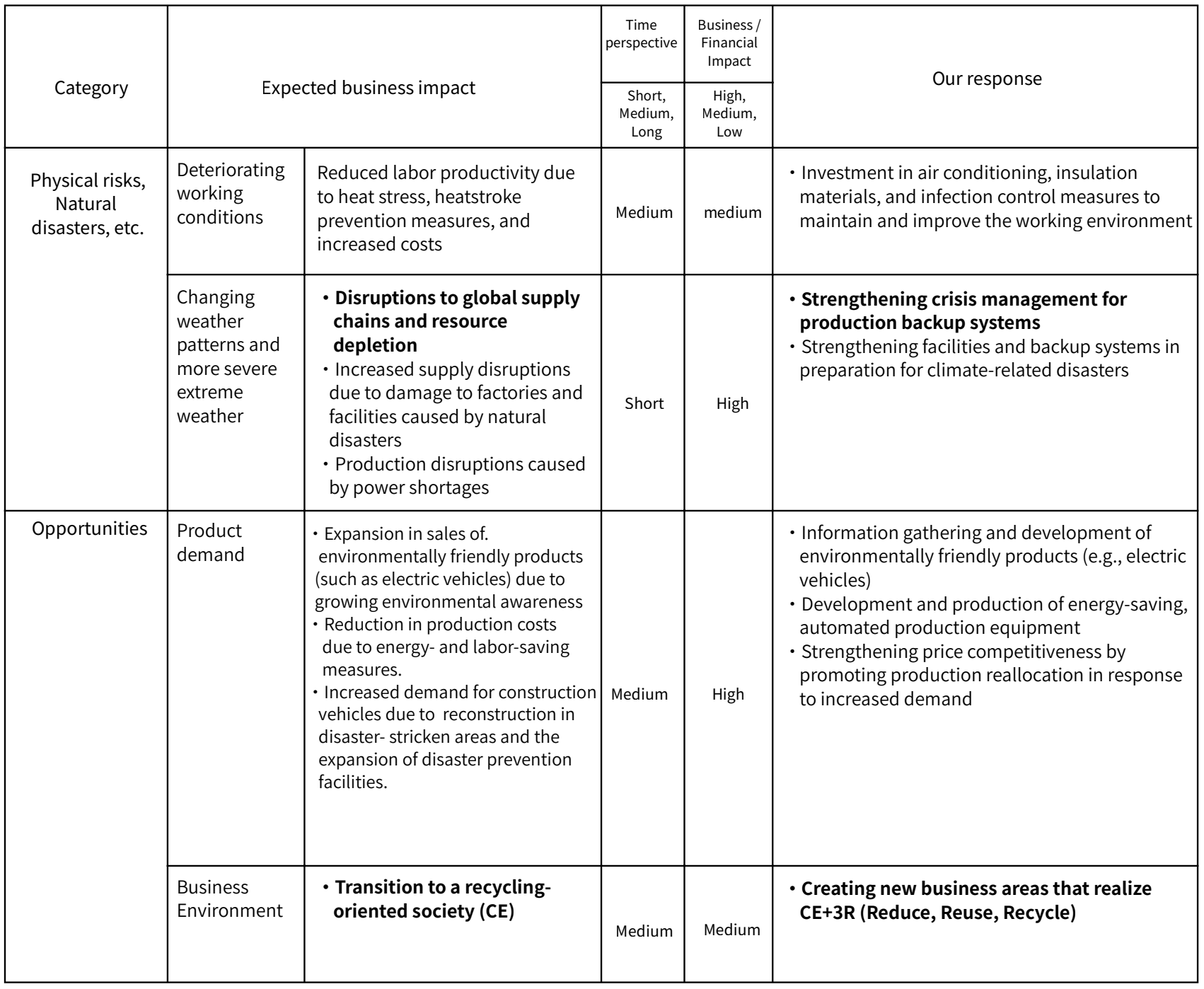
The risks and opportunities associated with climate change can be attributed to the transition to a decarbonized society, strengthening of regulations, technological developments, and changes in the market, or to the physical impacts of climate change, such asuch as the s acute abnormal weather and chronic warming. We categorize the factors behind various changes in the external environment caused by climate change into “transition risk” and
“physical risk.” We then assess the time perspective in three stages, long-, medium-, and short-term, and the business financial impact in three stages, large-, medium-, and small-to identify important risks and opportunities.

Metrics and Targets
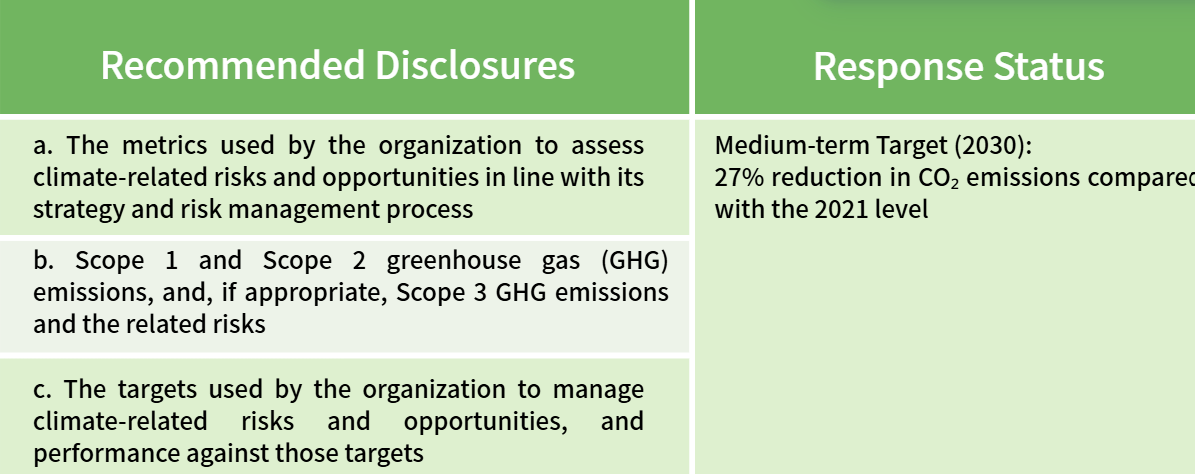
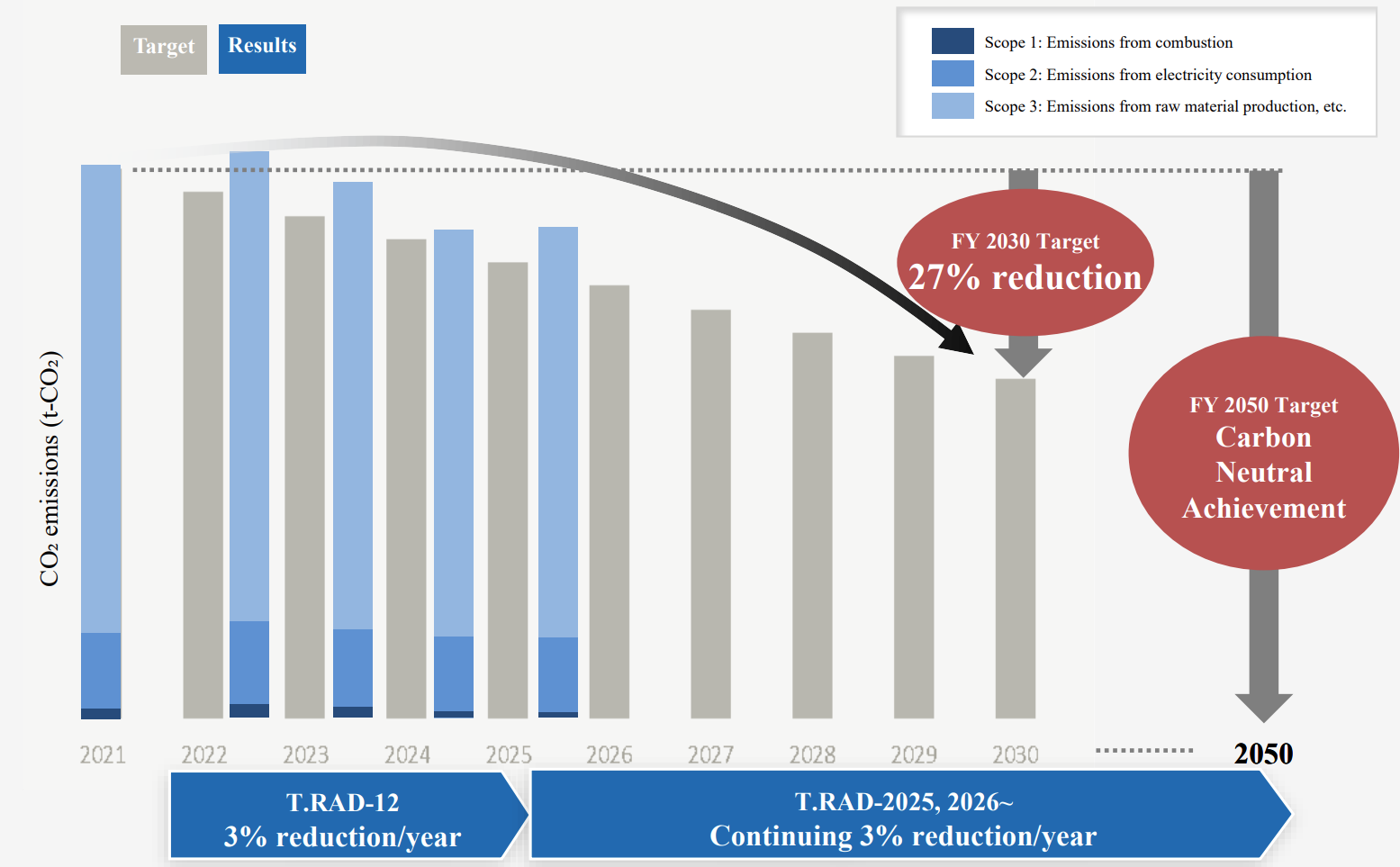
CO₂ emission reduction targets are incorporated into
T.RAD-2025. We have also established metrics and targets for environmental activities, including climate-related initiatives, and regularly monitor progress toward their achievement. The T.RAD Group has set a target of reducing net CO₂ emissions by 27% by 2030 compared with the 2021 baseline and achieving net-zero CO₂ emissions by 2050 (vs. 2021) and reach net zero by 2050.